Things I am Currently Working On
RSA Connect (mind-of-minds): developing a socio-technical architecture for collective intelligence for the RSA Fellowship.
DVAP (Density–Value–Accessibility paradox): DVAP (the Density–Value–Accessibility Paradox) describes what happens as a network gets “denser” (more active links per person): the network’s potential value rises as new connections create new possibilities, but accessibility falls because the system becomes harder for a human being to navigate without overload; the value people actually experience (“usable value”) is therefore highest at a mid-range “sweet spot” where there is enough activity to make discovery worthwhile, but not so much that attention collapses. In the model you’ve been using, value increases with diminishing returns (fast early gains, then a flattening curve), while accessibility falls with an exponential decline—meaning it drops rapidly at first and then tails off, because each extra step of “busy-ness” reduces navigability by a similar proportion rather than by a fixed amount (a “fast then slow” decay pattern).
Complexity and failure in public systems: Across infected blood, Shipman, King’s Cross, Alder Hey, rail privatisation crashes and Post Office Horizon, the repeating pattern is not simply error or misconduct but a systems failure: the public assumes a single coherent service, yet the reality is a set of semi-detached subsystems with weak or missing interfaces. In our framing, these failures fall into three types: (1) silo failure, where early warning signals exist but never cohere across organisational and professional boundaries (infected blood; Shipman); (2) fragmentation-by-design, where the system is structurally split into multiple contracting entities, multiplying seams and handovers without a compensating integration architecture (rail privatisation crashes); and (3) model failure and informational asymmetry, where a technical/administrative system becomes an unquestioned “single source of truth” and contrary evidence is suppressed or discounted (Post Office Horizon), with catastrophe often arriving when neglected learning about risk accumulates in the background (King’s Cross) or when split accountabilities create ethical blind spots (Alder Hey). The purpose of a system-of-systems architecture—an adaptive, query-driven network—is to make those interfaces explicit, so weak signals can be connected, uncertainty can be surfaced, and the shared picture can update fast enough to prevent harm rather than merely explain it afterwards.
The Four-Code Paradigm: refining a “four speeds of code” framing—Planetary, Biological (DNA), Cultural, and Software/AI—focused on synchronisation across tempos and the way fast code pressures slower layers.
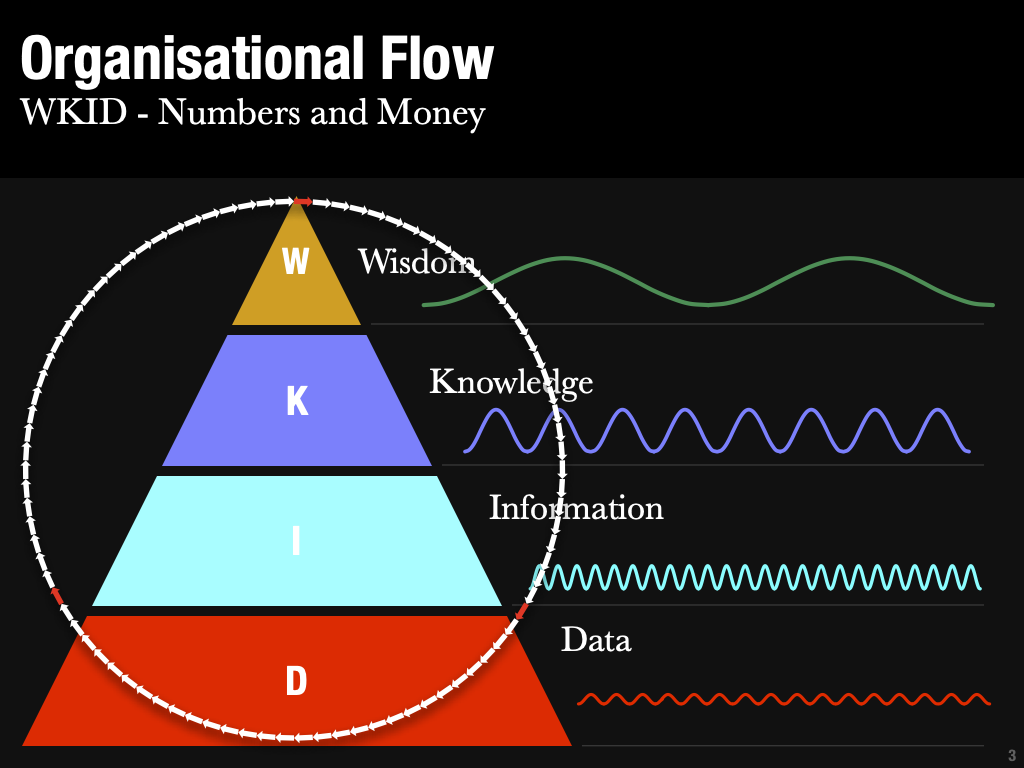
DIKW and code as transposition: explicitly using DIKW (Data → Information → Knowledge → Wisdom)as a practical ladder, and treating “code” as the rule-governed transposition layer that moves material between these states (and back again) in repeatable loops. This is old work from the Museums and Resilient Leadership programme
Hybridisation (analogue–digital–human interface): using the America’s Cup as a worked analogy for hybrid organisations—where advantage comes from integrating three realms (humans, analogue hardware, digital sensing/control) across design–build–train–race cycles.
E–O–H spine (Epistemology–Ontology–Heuristics): building a “warranted pipeline” in which ontology is treated as a living ledger, epistemology as the test suite, and heuristics as resource-bounded policies for action under uncertainty.
Hive-mind critique and collective intelligence: distinguishing sophisticated emergent coordination from genuine mentation, and arguing for an ontology-first account of what a collective system “is” (relational, not located in any one substrate).
Consciousness lenses as design tools: stress-testing active inference against alternatives (Global Workspace, IIT, recurrent processing, higher-order thought, attention schema, enactive/ecological views) and translating them into platform patterns (broadcast, boundary objects, attention controls, provenance).
Disavowal, climate, and AuHI: using Freud’s Verleugnung (disavowal) and Spaltung (splitting) to explain “a system that knows but does not act,” and positioning Augmented Human Intelligence as an integration mechanism across climate, economy, infrastructure, health, migration, and security.
Hinton ↔ Chomsky (and a critique of Hinton’s narrow framing): mapping contemporary deep-learning critiques back onto generative grammar, but arguing that a fair comparison must include the developmental and social substrate of language—reciprocal synchrony and turn-taking between infant and caregiver, and the wider linguistic community the infant gradually enters—rather than treating syntax as an isolated formal object divorced from embodied, meaning-making coordination.
Things I am Currently Working On
RSA Connect (mind-of-minds): developing a socio-technical architecture for collective intelligence for the RSA Fellowship.
DVAP (Density–Value–Accessibility paradox): DVAP (the Density–Value–Accessibility Paradox) describes what happens as a network gets “denser” (more active links per person): the network’s potential value rises as new connections create new possibilities, but accessibility falls because the system becomes harder for a human being to navigate without overload; the value people actually experience (“usable value”) is therefore highest at a mid-range “sweet spot” where there is enough activity to make discovery worthwhile, but not so much that attention collapses. In the model you’ve been using, value increases with diminishing returns (fast early gains, then a flattening curve), while accessibility falls with an exponential decline—meaning it drops rapidly at first and then tails off, because each extra step of “busy-ness” reduces navigability by a similar proportion rather than by a fixed amount (a “fast then slow” decay pattern).
Complexity and failure in public systems: Across infected blood, Shipman, King’s Cross, Alder Hey, rail privatisation crashes and Post Office Horizon, the repeating pattern is not simply error or misconduct but a systems failure: the public assumes a single coherent service, yet the reality is a set of semi-detached subsystems with weak or missing interfaces. In our framing, these failures fall into three types: (1) silo failure, where early warning signals exist but never cohere across organisational and professional boundaries (infected blood; Shipman); (2) fragmentation-by-design, where the system is structurally split into multiple contracting entities, multiplying seams and handovers without a compensating integration architecture (rail privatisation crashes); and (3) model failure and informational asymmetry, where a technical/administrative system becomes an unquestioned “single source of truth” and contrary evidence is suppressed or discounted (Post Office Horizon), with catastrophe often arriving when neglected learning about risk accumulates in the background (King’s Cross) or when split accountabilities create ethical blind spots (Alder Hey). The purpose of a system-of-systems architecture—an adaptive, query-driven network—is to make those interfaces explicit, so weak signals can be connected, uncertainty can be surfaced, and the shared picture can update fast enough to prevent harm rather than merely explain it afterwards.
The Four-Code Paradigm: refining a “four speeds of code” framing—Planetary, Biological (DNA), Cultural, and Software/AI—focused on synchronisation across tempos and the way fast code pressures slower layers.
DIKW and code as transposition: explicitly using DIKW (Data → Information → Knowledge → Wisdom)as a practical ladder, and treating “code” as the rule-governed transposition layer that moves material between these states (and back again) in repeatable loops. This is old work from the Museums and Resilient Leadership programme
Hybridisation (analogue–digital–human interface): using the America’s Cup as a worked analogy for hybrid organisations—where advantage comes from integrating three realms (humans, analogue hardware, digital sensing/control) across design–build–train–race cycles.
E–O–H spine (Epistemology–Ontology–Heuristics): building a “warranted pipeline” in which ontology is treated as a living ledger, epistemology as the test suite, and heuristics as resource-bounded policies for action under un
Hive-mind critique and collective intelligence: distinguishing sophisticated emergent coordination from genuine mentation, and arguing for an ontology-first account of what a collective system “is” (relational, not located in any one substrate).
Consciousness lenses as design tools: stress-testing active inference against alternatives (Global Workspace, IIT, recurrent processing, higher-order thought, attention schema, enactive/ecological views) and translating them into platform patterns (broadcast, boundary objects, attention controls, provenance).
Disavowal, climate, and AuHI: using Freud’s Verleugnung (disavowal) and Spaltung (splitting) to explain “a system that knows but does not act,” and positioning Augmented Human Intelligence as an integration mechanism across climate, economy, infrastructure, health, migration, and security.
Hinton ↔ Chomsky (and a critique of Hinton’s narrow framing): mapping contemporary deep-learning critiques back onto generative grammar, but arguing that a fair comparison must include the developmental and social substrate of language—reciprocal synchrony and turn-taking between infant and caregiver, and the wider linguistic community the infant gradually enters—rather than treating syntax as an isolated formal object divorced from embodied, meaning-making coordination.