A Note on Crossroads Dancing and the Law
The film clip is clearly staged for the camera and is a half-set danced at a Cork crossroads in 1929 — two couples ‘battering’ to the drive of fiddle and melodeon, in the Sliabh Luachra style that ran along the Cork-Kerry border. Crossroads dancing was the social heart of rural Ireland for over a century: flat ground, public land, a meeting point between townlands, and on a summer Sunday evening, all that was needed was a musician or two. The half-set took the figures of the full four-couple set and compressed them for the dancers to hand, a practical form for informal gatherings and for the size of the stage or platform. Within six years of this piece of film being shot, the Public Dance Halls Act of 1935 would effectively bring an end to the tradition, driving dancing indoors under licence and clerical supervision. Footage like this catches it in a living moment.
The Public Dance Halls Act, 1935
The Act was the second piece of legislation passed by the Oireachtas in 1935, commenced on 19 February. It required a licence from a District Court justice for any place used for public dancing, and it passed without serious Dáil debate — supported by Fianna Fáil, Fine Gael, Labour, the Catholic hierarchy and the Gaelic League alike. Its genesis was the 1932 Carrigan Commission report into juvenile sexual offences, which had denounced the "unlicensed dances held all over the country in unsuitable buildings and surroundings". The Criminal Law (Amendment) Act 1935 — raising the age of consent, banning contraception — was its twin, from the same report.
The Act never mentions the Catholic Church, but, of course, it doesn't have to. Three features of Section 2 do the work of control; Subsection (2)(f) requires the Justice to consider whether the place can be supervised by the Gárda Síochána — a criterion that effectively ruled out every crossroads, since a crossroads has no doors, no walls, no gatekeeper. Subsection (3) allows "any member of the Gárda Síochána and any person who appears to the Justice... to be interested" to oppose a licence; in rural Ireland in 1935, the interested party was always the parish priest. Subsection (2)(a) imports the "character" of the applicant into the decision, undefined in the Act and in practice, his to bestow.
The Act remains on the Irish statute book.
Bicycles and Dancing
We are all the product of a successful connection— successful in a simple biological sense. Click on the graphics below; the ‘Ancestor Tree’ takes you back to the 1700s, and the 'Tree Meets the Parish' interactive allows you to see how gene pool, local geography, and changing social, technological, and economic forces interact. The local marriageable or connection pool — what population genetics calls the effective population — is determined by the 'coupling horizon': how far a person could realistically travel to find a partner. Before the development of roads, railways and air travel, that horizon was probably 5-10 miles. The pool is a product of three coupled factors: how many settlements fall within that radius, how large they are, and what fraction of their inhabitants are of marriageable age. Change any one variable and the ceiling shifts. You can play with the sliders on the interactive graph below.
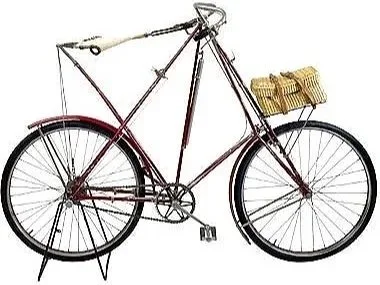
I have made the graphics with England in mind, so the Parish appears as the unit, rather than the townland for Ireland. There are equivalent geographies in all cultures. Because I am a huge fan of the bicycle, I’m bound to point out that for decades it was a powerful gene pool multiplier :-). The bicycle shown is the rare and wonderful Pedersen. Pedersen was Danish but he made the bicycles in Dursley at the end of the nineteenth and beginning of the twentieth centuries. Dursley is a market town and civil parish in the Stroud District of Gloucestershire, England. I have no evidence that a dance was ever cycled to in rural Ireland on such a bicycle. The bicycle of course is a key feature of the extraordinary Irish novel The Third Policemen, which features one of greatest creations in literature - Sergeant Pluck.
As for dancing, this clip shows Irish platform or crossroads dancing in County Cork in 1929. Ireland, because I am a huge admirer of the country and because this kind of ordinary, ancient human thing was made illegal in De Valera's Ireland by the Public Dance Halls Act of 1935. Evidence, if needed, of the close connection between church and state.